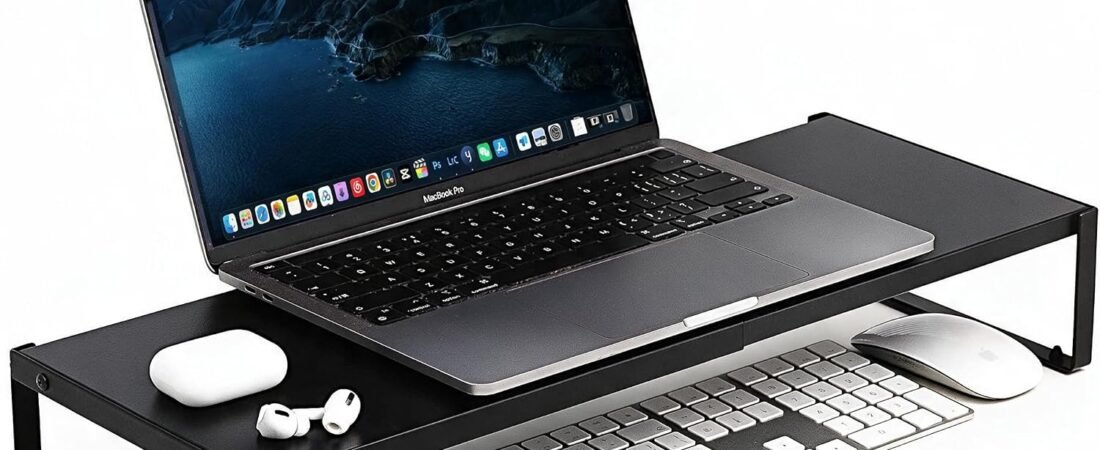
A well-organized desk can make everyday computer work more comfortable and efficient. Whether a workspace is used for office tasks, studying, programming, creative projects, gaming, or general browsing, the position of a monitor and laptop can have a noticeable effect on how the desk feels and functions. One practical way to improve desk organization is to use a monitor stand or laptop riser that adds height while also creating additional storage space underneath.
The Adjustable Computer Monitor Stand described here combines several useful desk-accessory concepts into one setup: monitor elevation, laptop support, adjustable positioning, and shelf-style organization. Its metal construction is designed for everyday desktop use, while the raised platform can help create a more structured arrangement for screens, notebooks, keyboards, and other frequently used items.
A monitor stand does not change the capabilities of a computer, but it can change how the computer equipment is positioned. Raising a display can help users establish a more comfortable viewing arrangement, while the open space beneath the stand can make better use of an otherwise unused part of the desk.
For people who alternate between a desktop monitor and laptop, an adjustable riser can also provide flexibility. Instead of treating the monitor stand as a permanent platform for one device, it can become part of a workspace system that changes depending on the task.
This guide explains the main features to consider, practical ways to use an adjustable computer monitor stand, situations where a laptop riser or desk shelf may be useful, and important factors to check before adding one to a workspace.
Understanding the Purpose of a Monitor Stand
A monitor stand is a relatively simple piece of desk equipment, but its purpose goes beyond simply lifting a screen.
Most computer desks provide a large horizontal surface. Without a stand, a monitor usually occupies some of that surface area, while the space directly underneath it remains difficult to use. A raised platform changes this arrangement by moving the monitor higher and creating a usable area beneath it.
That additional space can be used for smaller accessories such as a keyboard, mouse, notebook, headphones, USB accessories, or other desk items. Depending on the dimensions of the stand and the equipment being used, it can also provide a convenient place to temporarily store a laptop or other device.
Height adjustment adds another dimension. People differ in height, seating position, desk dimensions, and monitor preferences, so a fixed-height stand may not work equally well for every workspace. An adjustable design allows the user to find a position that fits their particular setup.
The goal is not necessarily to raise a screen as high as possible. Instead, the useful height is the one that works with the user’s chair, desk, monitor size, and normal viewing position.
Key Features of an Adjustable Computer Monitor Stand
Adjustable Height
One of the main characteristics of an adjustable monitor riser is the ability to change its working height.
A fixed stand places the monitor at one predetermined level. That can be perfectly adequate for some desks, but it provides less flexibility when the same desk is used by different people or for different activities.
An adjustable stand allows the display or laptop platform to be positioned at a more suitable height. The adjustment range can be particularly useful when moving between a laptop and an external monitor, because these devices often have different screen positions.
When adjusting the height, stability should remain a priority. A taller configuration creates a different center of gravity than a lower configuration, so the stand should be assembled and positioned according to its instructions rather than adjusted casually while carrying a heavy device.
Metal Construction
Metal is commonly used for monitor stands because it provides a rigid structure while allowing manufacturers to create relatively slim support components.
A metal desk shelf can also complement modern office furniture because it generally has a simple, functional appearance. Unlike some bulky furniture-style monitor platforms, a metal riser can maintain a more open visual structure around the desk.
The actual durability of any stand depends on its construction, materials, joints, fasteners, and load capacity. Users should therefore check the manufacturer’s stated weight limit rather than assuming that all metal stands can support the same equipment.
Laptop Riser Function
A laptop can be used directly on a desk, but its screen height is often much lower than that of a conventional external monitor.
Raising a laptop can make it easier to integrate into a larger workstation. For example, someone may use a laptop as the main computer while connecting it to an external keyboard and mouse. In that arrangement, the laptop display can serve as a second screen while sitting on a raised platform.
Another option is to place the laptop on the riser while using an external monitor as the primary display. This can create a two-screen arrangement without requiring a separate laptop stand.
The appropriate arrangement depends on the user’s workflow and the available desk space.
Desk Shelf Organization
The shelf concept is another important part of a monitor riser.
Instead of occupying the entire area under a monitor with cables and accessories, a raised platform can create a dedicated storage zone. A keyboard may slide underneath when it is not being used, freeing part of the desktop.
Small items can also be grouped underneath the stand. This can make the workspace feel less cluttered without requiring additional furniture.
However, it is useful to avoid turning the shelf into a storage area for heavy objects that are not intended to be placed there. The stand’s load capacity applies to the equipment and objects it supports.
Open Desk Design
Many monitor risers use an open structure rather than a completely enclosed cabinet-style design.
An open structure makes it easier to access items stored underneath and can also make cable routing more straightforward. USB cables, keyboard cables, charging cables, and display cables often need to move between devices on the desk and ports located behind or beside the computer.
Open space can also make cleaning easier. Dust and small debris are less likely to become trapped in an enclosed compartment.
How It Can Be Used in a Home Office
A home office is one of the most obvious environments for an adjustable monitor stand.
Many home workstations combine a desk, computer, keyboard, mouse, documents, phone, and other accessories in a relatively small area. As more equipment is added, the desk can quickly become crowded.
Raising the monitor creates a second level on the desk. The monitor occupies the upper level while the keyboard, notebooks, or smaller accessories can occupy the space below.
For a typical office workflow, the area beneath the stand could be used to store the keyboard when it is not being used. A notebook or document can then remain on the main desk surface.
The result is not additional desk area in the literal sense, but more efficient use of the existing surface.
Using It With a Laptop
Laptop users have several ways to incorporate a monitor riser into their setup.
A laptop can sit directly on the raised platform, providing additional screen height. This can be useful when the laptop is connected to an external keyboard and mouse.
Alternatively, a laptop can be positioned beside an external monitor. In this configuration, the stand can elevate either the monitor or the laptop depending on the desired screen alignment.
Dual-screen users may also find height consistency useful. If the laptop display and external monitor are positioned at very different levels, moving one device can make the workspace feel more visually organized.
The ideal arrangement will depend on the size of the laptop, monitor, desk depth, and user’s preferred viewing angle.
Creating a Dual-Monitor Workspace
People who use two displays often pay attention to screen alignment because monitors at noticeably different heights can make the workspace feel less organized.
A monitor stand can help establish a consistent elevation for one or more screens.
For example, a user might place a primary monitor on the stand while keeping a secondary display beside it. Alternatively, the stand can be used to elevate a laptop next to an external monitor.
When setting up multiple screens, users should consider more than height. Screen distance, viewing angle, available desk depth, cable routing, and the position of the keyboard and mouse all affect the overall arrangement.
The monitor stand is therefore one part of the workstation rather than a complete ergonomic solution by itself.
Making Better Use of Limited Desk Space
Small desks can benefit particularly from vertical organization.
When desk width is limited, adding another shelf or raised platform can help separate equipment into different levels. The monitor occupies the upper level while frequently used accessories can remain underneath.
This can be especially useful in bedrooms, dorm rooms, compact home offices, and shared work areas.
Instead of adding a larger desk, users can sometimes improve organization by changing how the existing surface is arranged.
A raised monitor platform can also provide a designated location for the display, making it easier to maintain consistent positioning after cleaning or rearranging the workspace.
Who May Find a Monitor Riser Useful?
Remote Workers
People working from home often build workstations from standard desks and consumer electronics rather than purpose-built office furniture.
An adjustable monitor stand can provide a simple way to organize the display and create more usable space around the keyboard and accessories.
Students
Students frequently have to work with limited desk space. A laptop, textbooks, notebooks, chargers, and stationery can compete for the same surface.
A desk shelf can help separate the computer from smaller study materials.
Programmers and Developers
Programming work often involves long periods of screen use and may require multiple windows or displays.
An elevated monitor can help create a more structured multi-screen workstation, while the space beneath it can accommodate a keyboard or smaller equipment.
Content Creators
Writers, designers, video editors, and other creators may work with several pieces of equipment at once.
A raised monitor can leave room for notebooks, drawing tablets, keyboards, or other accessories, depending on the size of the desk.
General Computer Users
The benefits are not limited to professional users. Anyone who wants a more organized computer desk can use a monitor stand as a straightforward workspace accessory.
Important Things to Consider Before Using a Monitor Stand
Check the Weight Capacity
The manufacturer’s stated weight limit should always be checked before placing a monitor, laptop, or other equipment on the stand.
A monitor’s weight may be listed in its technical specifications. Remember that accessories attached to the monitor can add weight.
If multiple objects will be placed on the stand, consider their combined weight rather than looking only at the weight of the primary device.
Measure the Desk
A monitor stand occupies horizontal space even though it creates additional vertical space.
Before setting one up, measure the available desk depth and width. Make sure the stand does not extend beyond the desk surface or interfere with other equipment.
Desk dimensions become particularly important when using large monitors, speakers, docking stations, or multiple displays.
Consider Monitor Size
A larger monitor may have a wider footprint than expected, particularly if it uses a broad factory stand.
Check the dimensions of the monitor base and compare them with the usable surface area of the riser.
For monitors mounted using a VESA arm, the situation may be different because the display itself may not sit directly on the stand.
Think About Height Carefully
Higher is not automatically better.
The useful height depends on the user’s seating position, desk height, monitor dimensions, and viewing preferences. The objective should be a comfortable and practical arrangement rather than maximizing the stand’s adjustment range.
If the screen becomes too high, the user may end up looking upward more than intended.
Keep the Stand Stable
Stability matters whenever a monitor or laptop is elevated.
The stand should rest on a level surface, and adjustable components should be properly secured. Avoid placing heavy objects near an unsupported edge.
It is also worth checking the stand periodically if it is frequently adjusted.
Leave Enough Ventilation
Laptops generate heat, particularly during demanding workloads.
If a laptop is placed on a raised platform, make sure the computer’s ventilation openings are not blocked. The exact location of those vents differs between models.
A stand with an open structure may allow more airflow around a laptop than a solid surface, but users should still follow the computer manufacturer’s ventilation recommendations.
Monitor Stand vs. Laptop Stand vs. Desk Shelf
These categories overlap, but they are designed around somewhat different needs.
Monitor Stand
A monitor stand primarily raises a desktop display and often creates storage space underneath.
It can work well when the main goal is monitor elevation and desk organization.
Laptop Stand
A laptop stand is generally designed around the dimensions and weight distribution of a portable computer. Many are angled or shaped specifically for laptop use.
A laptop stand can be more compact than a full desk shelf and may offer greater flexibility for someone who frequently moves the computer.
Desk Shelf
A desk shelf focuses more strongly on organization and storage. It may support a monitor, but its main purpose can be creating another level of usable space.
An adjustable monitor stand with a shelf-like structure combines aspects of these categories.
The appropriate choice depends on whether the priority is screen height, laptop positioning, storage, portability, or a combination of these functions.
Cable Management and Workspace Organization
One of the practical advantages of raising equipment is the additional space available for cable organization.
A typical computer desk may contain cables for power, HDMI or DisplayPort, USB devices, speakers, charging equipment, and networking.
Without organization, these cables can spread across the desktop and become difficult to identify.
The space beneath a monitor shelf can provide a natural route for some cables, but users should avoid creating tight bends or placing cables where they can be pulled accidentally.
Power cables should also remain accessible enough to disconnect when necessary.
A few simple habits can make the setup easier to maintain:
- Group cables according to device.
- Keep power and data cables organized rather than tangled.
- Leave enough slack for normal device movement.
- Avoid routing cables where chair wheels can catch them.
- Keep charging connectors accessible.
- Avoid placing cables directly underneath heavy equipment.
The monitor stand itself does not replace dedicated cable-management accessories, but it can provide a more structured foundation for organizing them.
Keeping the Workspace Comfortable
A monitor stand can contribute to a more comfortable workspace, but it should be considered part of a larger setup.
Chair height, desk height, monitor distance, keyboard position, lighting, and break habits all matter.
A useful starting point is to position the monitor so that the user’s normal viewing posture feels natural. The exact position varies from person to person.
The keyboard and mouse should remain easy to reach without requiring unnecessary stretching. If the monitor is elevated while the keyboard stays at desk level, the two components can be positioned independently.
This flexibility is one reason a raised monitor platform can be useful in a workstation where the computer display and input devices need different vertical positions.
Maintenance and Long-Term Use
A metal monitor stand generally requires little maintenance, but basic care can help preserve its condition.
Dust can accumulate around joints, corners, and underneath the platform. Cleaning the stand periodically can prevent debris from building up around adjustable components.
If the stand uses screws or adjustable fittings, inspect them occasionally, particularly if the stand is moved frequently.
Do not use excessive force when adjusting height. If a component appears stuck, check the manufacturer’s instructions instead of forcing it.
The surface should also be kept reasonably dry and clean. Cleaning products should be compatible with the stand’s finish.
Common Workspace Mistakes to Avoid
Even a useful desk accessory can become less effective when it is poorly configured.
One common mistake is placing too much weight on the stand simply because there is available surface area. A monitor stand is not automatically a general-purpose storage shelf.
Another mistake is ignoring desk dimensions. A stand that fits a small monitor may not provide enough surface area for a large display.
Users should also avoid blocking ventilation openings on laptops or docking equipment.
Cable routing is another frequently overlooked detail. A beautifully organized monitor arrangement can quickly become messy if cables are stretched across the desk.
Finally, users should remember that a monitor stand cannot compensate for an unsuitable chair or desk. Workspace comfort is influenced by the complete setup.
Frequently Asked Questions
What is an adjustable computer monitor stand?
An adjustable computer monitor stand is a desktop platform designed to raise a monitor or compatible computer equipment while allowing some adjustment to its position or height. Many designs also create storage space underneath the display.
Can a monitor stand be used for a laptop?
Yes, provided the laptop fits securely within the stand’s usable surface area and its weight is within the manufacturer’s stated capacity. A raised laptop can be useful when the computer is connected to an external keyboard and mouse.
Does raising a monitor improve ergonomics?
Raising a monitor can help users establish a more suitable screen position, but ergonomics depends on the entire workstation. Chair height, desk dimensions, screen distance, keyboard position, and individual preferences all contribute to comfort.
Can I put a keyboard underneath the monitor stand?
Many desk-shelf designs provide open space underneath that can accommodate a keyboard. The available clearance depends on the stand’s height and the keyboard’s dimensions.
Is a metal monitor stand durable?
Metal construction can provide a rigid support structure, but durability depends on the specific design, materials, joints, and manufacturing quality. Users should also stay within the stated weight capacity.
Can I use a monitor stand with two screens?
That depends on the dimensions and load capacity of the stand. If both displays cannot safely fit on the platform, the stand may be more appropriate for one monitor while the second display uses its own support or mounting system.
Is a monitor stand suitable for a small desk?
It can be. The raised platform creates another level of usable space, which may help organize equipment on a compact desk. However, the stand itself still requires adequate surface area.
Can a monitor stand help organize cables?
It can provide additional space and make cable routing easier, but it is not a dedicated cable-management system. Cable clips, sleeves, or channels may still be useful for a more structured setup.
Should a laptop be placed directly on a monitor riser?
If the stand is designed to support the laptop’s size and weight, it can be used that way. Users should make sure the laptop is stable and that its ventilation openings remain unobstructed.
How high should a monitor be?
There is no single height that works for everyone. The appropriate position depends on the user’s posture, chair, desk, monitor size, and viewing preferences. The purpose of an adjustable stand is to provide flexibility rather than force one fixed position.
Conclusion
An adjustable computer monitor stand can be a practical addition to a modern workstation because it combines several functions that are often needed at the same time. It can raise a monitor, provide a platform for compatible laptops, and create additional storage space beneath the display.
The metal construction and adjustable design can make this type of desk accessory suitable for a range of environments, from home offices and student desks to more equipment-heavy computer workstations. Its usefulness ultimately depends on how well its dimensions, weight capacity, height range, and layout match the equipment already on the desk.
For users working with limited surface area, the shelf-style arrangement can be particularly useful because it introduces vertical organization without requiring a larger desk. The space beneath the monitor can accommodate a keyboard, notebook, or smaller accessories, helping keep frequently used items organized.
At the same time, a monitor riser should be viewed as one component of a complete workstation. Proper screen positioning, suitable seating, adequate ventilation, safe cable routing, and reasonable weight distribution remain important.
Before choosing a configuration, measure the desk, check the dimensions and weight of the equipment, and consider how the stand will fit into the user’s normal workflow. A thoughtful setup can make better use of existing desk space while providing more flexibility for monitors and laptops.