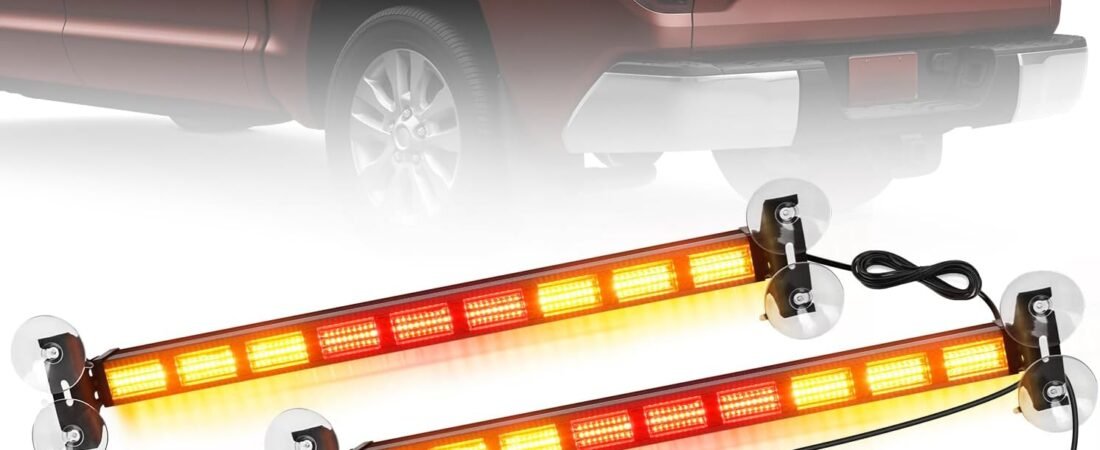
Visibility is an important consideration for vehicles that operate around traffic, work along roadsides, perform towing or recovery work, or operate in areas where other drivers need to recognize a vehicle’s presence. In these situations, auxiliary warning lighting can provide an additional visual signal beyond a vehicle’s standard lighting system.
The Nilight 162 LED Traffic Advisor Strobe Light Bar with Controller in Amber Red is a dual-section warning-light system designed around this concept. According to the manufacturer’s current product information, the light bar uses 162 LEDs, offers multiple selectable flash patterns, supports switchable color configurations, and includes a controller for operating the lighting functions. The manufacturer lists applications including trucks, towing vehicles, construction vehicles, snowplows, and other work-oriented vehicles.
Rather than viewing a traffic advisor as simply another vehicle light, it is useful to understand what this type of equipment is designed to accomplish. A warning light can help make a vehicle more visually noticeable, but its usefulness depends on appropriate installation, visibility, vehicle type, operating conditions, and compliance with applicable laws.
This article examines the Nilight 162 LED Traffic Advisor in that broader context. It explains its major features, potential applications, controller functions, installation considerations, differences between traffic advisors and other vehicle lighting categories, and important legal and safety considerations that should be understood before using colored warning lights on public roads.
Understanding What a Traffic Advisor Light Bar Does
A traffic advisor is different from a conventional headlight, fog light, driving light, or work light.
Headlights are primarily intended to illuminate the road ahead so the driver can see. Work lights provide illumination around a vehicle or work area. A traffic advisor, by contrast, is intended primarily to communicate a visual warning or directional signal to people outside the vehicle.
This distinction matters because the purpose of the light is not simply brightness.
A traffic advisor may use sequential or directional flashing patterns to communicate that a vehicle is stopped, working, towing, clearing an area, or otherwise requiring additional attention. The exact meaning of a particular color or pattern, however, depends on the jurisdiction and application.
The Nilight 162 LED model is described by its manufacturer as a 2-in-1 traffic advisor and emergency warning light with multiple color and flash-pattern options.
That combination makes it more configurable than a basic single-mode warning lamp, but the additional flexibility also means that users need to understand how their selected lighting configuration should be used.
Key Features of the Nilight 162 LED Traffic Advisor
162 LED Light Configuration
The system uses 162 LED light sources across its traffic-advisor assembly.
LED technology is commonly used for vehicle warning lights because LEDs can provide strong illumination from relatively compact modules while allowing manufacturers to create different flashing sequences.
The number of LEDs alone does not determine how effective a warning light will be. Actual visibility depends on factors such as optical design, lens construction, viewing angle, ambient lighting, weather conditions, installation position, and the distance between the light and an observer.
For that reason, the 162-LED specification is best understood as one part of the overall lighting design rather than a standalone measure of performance.
Amber and Red Color Configuration
The product is identified as an Amber Red version. Nilight’s product listing identifies the model as a 2-in-1 Amber Red traffic advisor with switchable color functionality.
Different warning-light colors can have different legal meanings depending on where a vehicle is operated.
Amber is commonly associated with warning, service, maintenance, construction, utility, towing, and other work-related applications in many jurisdictions. Red lighting can be subject to substantially more restrictive rules because red is commonly associated with emergency vehicles.
That means the presence of a red lighting option should not be interpreted as permission to use it freely on a privately owned vehicle.
Users should always verify the applicable state, provincial, local, or national regulations before operating colored warning lights on public roads.
36 Flash Patterns
The manufacturer lists 36 selectable flash patterns for this model.
Multiple patterns can be useful because different work environments may require different visual signaling characteristics.
Some situations may call for an alternating pattern, while others may benefit from a directional sequence or another configuration. The appropriate pattern depends on the vehicle’s role and the surrounding environment.
Having many patterns does not mean that every pattern is appropriate for every situation. A highly active flashing sequence may attract attention, but it can also become distracting depending on the circumstances.
The operator should select a configuration that is appropriate for the vehicle’s lawful use and the environment.
Four Switchable Color Configurations
Nilight describes the 162 LED product family as having four switchable color patterns. The manufacturer’s product page lists multiple variants in the same series, including Amber Red, Amber Green, Amber White, Red Blue, and other combinations.
For the Amber Red version specifically, the relevant configuration is the amber/red combination.
The ability to switch lighting configurations can be useful for applications where a vehicle may perform different types of work, but users should not assume that every available color combination is legal for every vehicle.
The lighting function should always be subordinate to the regulations governing the vehicle and its intended use.
Handheld Controller
The light bar is supplied with a controller that allows the operator to manage the available lighting functions.
A dedicated controller can be more practical than repeatedly interacting with the light bar itself because the operator can select functions from a centralized location.
The manufacturer’s current product information also describes a memory function that recalls the lighting mode used previously.
This can be convenient for users who consistently operate the same configuration.
At the same time, a memory feature means operators should check the selected mode before driving or beginning work rather than assuming that the light will always start in the desired configuration.
How the Light Bar Can Be Used
Towing and Recovery Vehicles
Towing and roadside-recovery vehicles frequently operate around moving traffic.
A warning light can help make a stopped or slow-moving work vehicle more noticeable, particularly when the vehicle is positioned near a roadway.
For a tow truck operator, the lighting system can become part of a larger visibility strategy that includes the vehicle’s standard hazard lights, reflective markings, work-area positioning, and other legally required equipment.
A warning light should not replace safe positioning or other required safety procedures.
Construction Vehicles
Construction equipment and support vehicles may operate near active traffic lanes, temporary work zones, or areas where normal road conditions change.
A traffic advisor can provide an additional visual indication that a vehicle is performing work.
Depending on the vehicle and jurisdiction, amber warning lighting may be appropriate for these applications. The exact requirements should be verified locally.
Snowplows and Winter-Service Vehicles
Snowplows and winter maintenance vehicles can encounter reduced visibility due to snow, fog, road spray, and changing weather conditions.
A dedicated warning light can help identify a working vehicle to surrounding traffic.
However, adverse weather also affects the visibility of warning lights. Snow accumulation, road grime, ice, and moisture on the lens can reduce the effectiveness of any warning-light system.
Regular cleaning and inspection are therefore particularly relevant for vehicles operating in winter environments.
Utility and Maintenance Vehicles
Utility crews, road maintenance workers, roadside service vehicles, and other mobile maintenance operations may use warning lights to make their vehicles more visible while working.
The suitability of the Amber Red configuration depends on the organization’s vehicle classification and applicable regulations.
Organizations should establish standardized operating procedures rather than leaving color and flash-pattern decisions entirely to individual operators.
Work Trucks and Fleet Vehicles
A fleet of service vehicles may benefit from having standardized warning-light equipment.
Consistency can simplify operator training and maintenance because drivers become familiar with the same controller layout and lighting functions.
Before adding warning lights to a fleet, however, the fleet operator should verify that the selected lighting configuration complies with the laws applicable to each operating area.
Understanding the Controller
The controller is an important part of a multi-pattern traffic advisor.
With numerous selectable flash modes, a controller provides the interface through which the operator chooses the appropriate lighting configuration.
This can be particularly useful when the vehicle is stationary at a work site and the operator needs to change the warning pattern without physically reaching toward the light bar.
A good operating practice is to familiarize the driver or equipment operator with the controller before the vehicle is used in an active work environment.
Controls should be positioned where they can be accessed without creating unnecessary distraction. Drivers should not attempt complicated adjustments while actively driving unless the system and circumstances permit safe operation.
If a lighting pattern needs to be changed frequently, it may be preferable to configure the desired mode before entering traffic or beginning work.
Installation and Mounting Considerations
The manufacturer describes this model as using an adjustable mounting arrangement and suction cups, with the product information also mentioning adhesive mounting support.
This type of mounting can be useful when a vehicle does not require a permanently drilled installation.
However, temporary mounting does not mean that installation can be ignored.
The light should be positioned securely and in a location where it remains visible without obstructing the driver’s view or interfering with vehicle equipment.
Before installation, consider:
- Windshield visibility
- Driver sight lines
- Airbag deployment areas
- Dashboard-mounted equipment
- Windshield sensors and cameras
- Wiper movement
- Door and window operation
- Cable routing
- Mounting-surface cleanliness
- The ability to remove the light when it is not needed
A light bar that becomes loose while a vehicle is moving can create a hazard. Mounting points should therefore be inspected regularly.
Cable Management and Power
The manufacturer states that the system is designed for 12V–24V vehicle applications and includes a cigarette-lighter power connection. Its product information also describes long cables intended to provide installation flexibility.
Long cables can be useful because vehicles differ considerably in size and interior layout.
However, extra cable length should be managed carefully.
Cables should not hang near pedals, steering mechanisms, moving seats, doors, or other mechanical components. They should also be protected from sharp edges and excessive heat.
If the vehicle has a different electrical configuration, users should verify compatibility before connecting the product.
A cigarette-lighter connection can make installation relatively straightforward, but users should not assume that every vehicle’s auxiliary outlet is identical. The vehicle’s electrical specifications and the light manufacturer’s requirements should be checked.
Why Lens Material Matters
Nilight identifies the lens material as polycarbonate in the product specifications.
Polycarbonate is commonly used in automotive lighting because it can provide a combination of transparency and impact resistance.
The lens is an important part of a warning light because it helps distribute and transmit the light produced by the LEDs.
Keeping the lens clean is therefore more than an appearance issue.
Dust, road film, salt, mud, snow, and other contamination can reduce visible output. A simple inspection before use can help identify problems that may otherwise go unnoticed.
Cleaning should be performed using methods appropriate for the lens material. Abrasive cleaners or aggressive solvents should be avoided unless the manufacturer specifically indicates that they are compatible.
Aluminum Housing and Heat Management
The manufacturer describes the light bar as using an aluminum housing and identifies heat management as part of its design.
Heat is an important consideration for LED electronics.
Although LEDs generally produce less wasted heat than traditional incandescent lighting, high-output LED systems still generate heat that must be managed.
An aluminum housing can help transfer heat away from internal components.
Users should avoid covering ventilation or placing the light in a way that prevents normal heat dissipation.
The manufacturer’s product information also states a potential service life of up to 50,000 hours. This should be understood as a manufacturer’s specification rather than a guarantee of how long an individual unit will operate in every environment.
Actual service life can depend on operating conditions, electrical supply, temperature, vibration, moisture, installation quality, and other factors.
Who May Find This Type of Light Useful?
Towing Professionals
Tow operators may use warning lighting as part of their roadside visibility equipment, subject to local regulations.
Construction Crews
Construction vehicles working around roadways may need additional warning visibility, particularly when operating near moving traffic.
Road Maintenance Teams
Municipal and private maintenance vehicles can use appropriate warning systems when performing work near roads.
Snow and Ice Removal Operators
Snowplows and winter-service vehicles may benefit from additional visibility during poor weather, provided the lighting configuration complies with local requirements.
Utility and Service Fleets
Companies operating maintenance trucks may use traffic advisor systems as part of their vehicle safety equipment.
Private Vehicle Owners
Private owners should exercise additional caution.
Owning a warning light does not automatically authorize its use on public roads. Color restrictions, flashing patterns, mounting requirements, and permitted vehicle categories can vary significantly.
For private vehicles, the first question should be whether the intended lighting configuration is legally permitted for that specific vehicle and purpose.
Important Legal Considerations for Amber and Red Warning Lights
This is one of the most important topics when discussing a product like the Nilight 162 LED Traffic Advisor.
Vehicle warning-light regulations vary by jurisdiction.
Amber lights are often associated with service, maintenance, construction, towing, and other warning applications, but exact rules differ between states and local authorities.
Red warning lights can be more heavily regulated because they may be associated with emergency-response vehicles.
The fact that a product is commercially available does not establish that every color or flash pattern can legally be used on every vehicle.
Users should check the laws that apply to:
- Their vehicle type
- Their occupation or organization
- The road on which the vehicle will operate
- The selected light color
- The selected flash pattern
- The mounting position
- Whether the vehicle is stationary or moving
- Whether the vehicle is authorized for emergency or warning-light use
The safest approach is to verify the requirements with the relevant motor-vehicle authority or other applicable official source before using colored warning lights on public roads.
A warning-light product should never be used to suggest that a vehicle has emergency-service authority when it does not.
Visibility Is Not the Same as Safety
A bright warning light can increase the visual presence of a vehicle, but it cannot guarantee that another driver will see or respond to it correctly.
Traffic conditions can be unpredictable. Drivers may be distracted, visibility may be poor, and warning lights can compete with headlights, streetlights, construction lighting, and other visual signals.
For that reason, a traffic advisor should be considered one part of a broader vehicle-safety approach.
Other factors may include:
- Proper vehicle positioning
- Reflective markings
- Cones and warning signs where appropriate
- Hazard lights
- High-visibility clothing
- Safe work-zone procedures
- Appropriate roadside protection
- Communication between workers
The lighting system should support these measures rather than replace them.
Traffic Advisor vs. Beacon Light
A traffic advisor and a rotating or flashing beacon can both serve warning purposes, but they are designed differently.
A beacon typically produces a concentrated warning signal from a single housing and may be mounted on a roof or another elevated location.
A traffic advisor light bar is often longer and can create a wider visual field. Some designs are specifically intended to provide directional or sequential patterns.
The appropriate category depends on the vehicle, installation location, required visibility, and legal requirements.
Neither category is automatically suitable for every application.
Traffic Advisor vs. Light Bar
The phrase “light bar” can refer to several different types of vehicle lighting.
A driving light bar is generally designed to illuminate the road or surrounding terrain.
A traffic advisor is primarily a warning device.
The two products can look superficially similar, but their purposes are different.
Using a warning light as though it were a driving light is not an appropriate substitute for purpose-designed forward illumination.
Likewise, a conventional off-road light bar should not automatically be treated as a legally compliant warning device.
Understanding the intended function is important when selecting vehicle lighting.
Traffic Advisor vs. Emergency Lighting Systems
Professional emergency vehicles may use specialized lighting systems that are designed around specific vehicle classifications, regulations, and agency requirements.
A commercially available traffic advisor should not automatically be treated as equivalent to an emergency-vehicle lighting system.
Professional systems may have additional specifications, certifications, mounting requirements, controls, and integration features depending on the jurisdiction and agency.
For official emergency vehicles, the appropriate equipment should be determined according to the requirements of the relevant organization and authority.
Maintenance and Inspection
A warning light should be inspected periodically, particularly if the vehicle operates in demanding environments.
Useful inspection points include:
Lens Condition
Look for cracks, heavy dirt, clouding, or other damage.
Mounting Security
Check suction cups, brackets, adhesive surfaces, and other mounting components.
Cable Condition
Look for cuts, exposed conductors, pinched sections, or damage around connectors.
Controller Operation
Make sure the controls respond correctly and that the selected mode behaves as expected.
Electrical Connection
Inspect the power connection for signs of damage, looseness, or overheating.
Lighting Output
Check whether all sections illuminate as intended. A partial failure may not be obvious during normal daytime operation.
Regular inspection is particularly important for equipment exposed to vibration, dust, rain, snow, mud, or frequent installation and removal.
Practical Setup Considerations
A well-planned installation begins with the vehicle rather than the light.
First, determine where the warning light needs to be visible from. Then identify a mounting location that provides that visibility without interfering with normal vehicle operation.
Next, consider how the cable will reach the power connection.
Finally, confirm that the controller can be operated safely.
This approach is more reliable than choosing a mounting position first and attempting to solve visibility and cable-routing problems afterward.
For temporary installations, the mounting surface should be clean and dry before attaching the appropriate mounting components. The attachment should then be checked before driving.
Frequently Asked Questions
What is the Nilight 162 LED Traffic Advisor?
It is a multi-pattern LED vehicle warning light system designed as a traffic advisor. The Amber Red version uses 162 LEDs and includes a controller with selectable lighting patterns and color functions. Nilight lists it for applications including trucks, towing, construction, plowing, and other work-oriented vehicles.
How many flash patterns does it have?
Nilight lists 36 selectable flash patterns for the 162 LED traffic advisor series.
What colors does the Amber Red version use?
The specific version discussed here is the Amber Red configuration. Nilight also sells other color combinations within the same 162 LED product family.
Can this light be used on any vehicle?
The manufacturer’s specifications describe the product as having universal vehicle fitment and list applications including trucks and other vehicle types. However, physical compatibility and legal authorization are different questions. Users must verify whether the lighting configuration is permitted for their particular vehicle and use.
Is red warning lighting legal on a private vehicle?
That depends on the jurisdiction, vehicle classification, and purpose. Red warning lights can be subject to specific restrictions. The product’s availability does not establish legal authorization for a particular vehicle.
Can it be used for construction work?
The manufacturer lists construction vehicles among the intended application categories. Actual use should still follow the requirements applicable to the specific vehicle and work site.
Is the light suitable for towing vehicles?
Towing is one of the applications identified by the manufacturer. Operators should verify the warning-light regulations that apply to tow vehicles in their area.
Does the light require permanent installation?
The manufacturer describes an adjustable mounting system with suction cups and adhesive support, allowing installation without necessarily drilling into the vehicle. Mounting should still be secure and appropriate for the vehicle and operating conditions.
Does it work with 12V and 24V vehicles?
Nilight’s product information describes the 162 LED series as suitable for 12V–24V vehicles. Users should still confirm their vehicle’s electrical configuration and follow the manufacturer’s installation instructions.
Does the controller remember the previous lighting mode?
Nilight describes a memory function that recalls the last lighting mode used. Operators should nevertheless verify the selected setting before use.
Is an LED traffic advisor a replacement for hazard lights?
Not necessarily. A traffic advisor serves a different purpose and may be subject to different requirements. Vehicle hazard lights and other legally required lighting should continue to be used as required.
Can a warning light guarantee that other drivers will see a vehicle?
No. Visibility can be affected by weather, traffic, road conditions, viewing angle, surrounding lighting, and driver behavior. A warning light should be treated as one component of a broader safety strategy.
Conclusion
The Nilight 162 LED Traffic Advisor Strobe Light Bar with Controller in Amber Red is designed around the needs of vehicles that require additional visual warning capability. Its 162-LED configuration, selectable flash patterns, controller, switchable color functionality, adjustable mounting system, and vehicle-oriented design give it several potential applications in towing, construction, road maintenance, snow removal, utility work, and similar environments.
The most important consideration, however, is not simply how many LEDs or flash patterns a warning light provides. The effectiveness of a traffic advisor depends on appropriate placement, secure mounting, correct electrical installation, clean lenses, suitable operating conditions, and responsible use.
Legal requirements deserve particular attention with an Amber Red warning system. Warning-light colors and flashing configurations can be regulated differently depending on the jurisdiction and vehicle type. Red lighting may have restrictions that do not apply to ordinary vehicle lighting, and the presence of a red function on a commercially available product does not by itself make its use legal.
For anyone considering this type of equipment, the sensible approach is to first identify the intended vehicle and application, verify the applicable regulations, check the electrical requirements, measure the available mounting area, and determine how the controller and wiring can be positioned safely.
Used within an appropriate vehicle-safety system and according to applicable requirements, a traffic advisor can serve as a useful visual communication tool for work vehicles and roadside operations.